Dimension refers to the size of the space inhabited by the world of our story. A large vista of a stage design can make an opera feel epic. A small stage that ends in blackness can feel tight, intimate, but hopeless as we look into the endless void.
Focus refers to the area of stage that wants to draw our attention. In film, we achieve this by using a tight frame, a wide frame, or somewhere in between. On stage, we can light the whole stage so that it can be seen, but only a smaller portion of the stage can be lit such that it draws our attention, draws our focus.
Controlling the Element
Altering focus and dimension is a balance between the fixtures hung and the cues that you program. It requires intentionality at the outset of your process, ensuring your light plot can achieve your artistic goals – then follow through as you program to utilize the granularity you prepared.
Foreground and Background
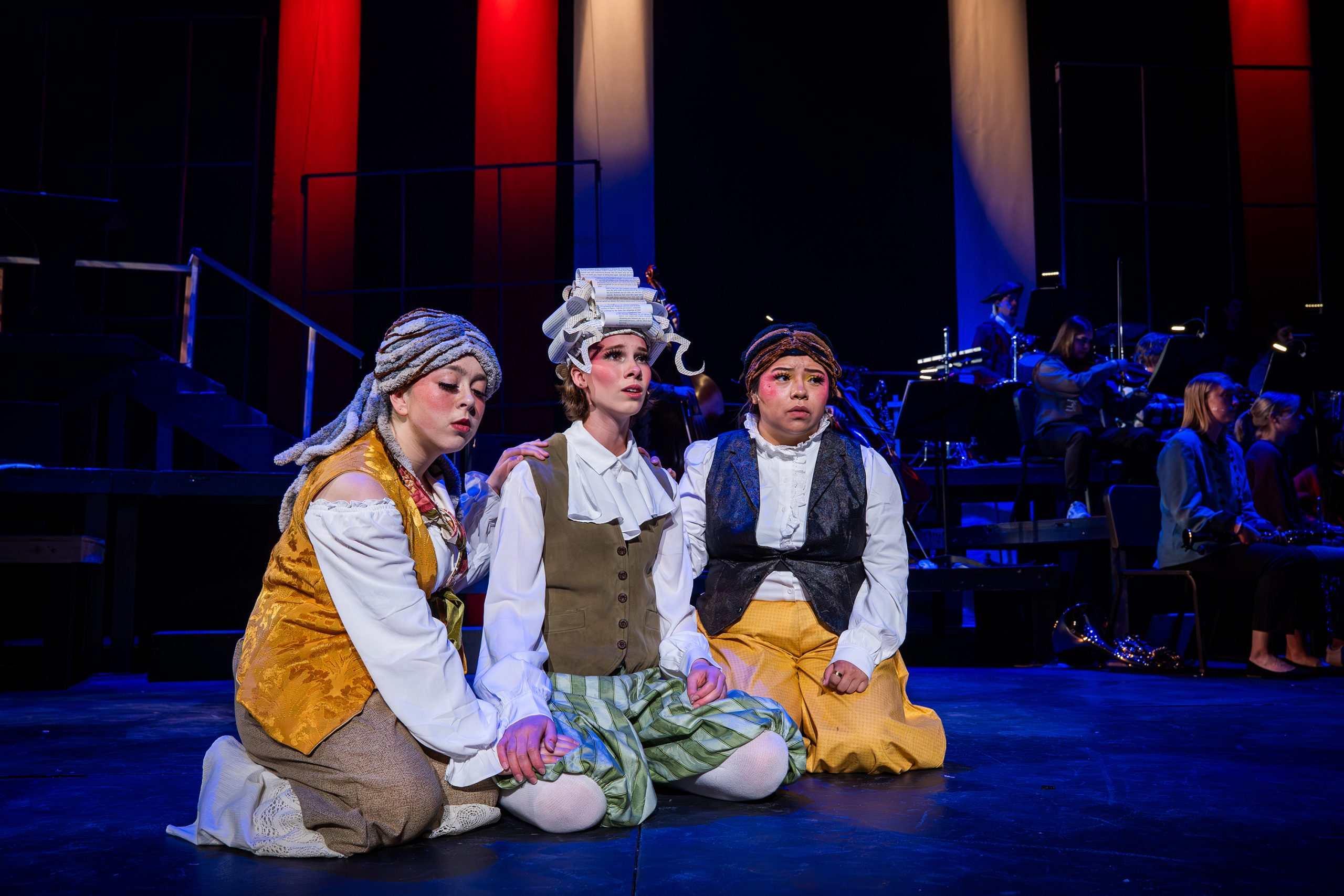
In order to create focus, it needs to be visually separated from what’s around it or what’s behind it. We can use elements such as Intensity, Direction, and Color to help accomplish this task. For example, in the image below you can see that the three actors singing together are lit by a bright white light while surrounded by a deeper, saturated color. The band members in the background are quickly ignored and your focus is drawn to the trio. Further, the curtains in the far background are lit at a much lower intensity, so while they don’t draw focus, they’re also not forgotten. In this image, there is no “blank canvas” or “unpainted stage”, but there is obviously only one place that we want to look – the actors singing in the center.
Beam Size
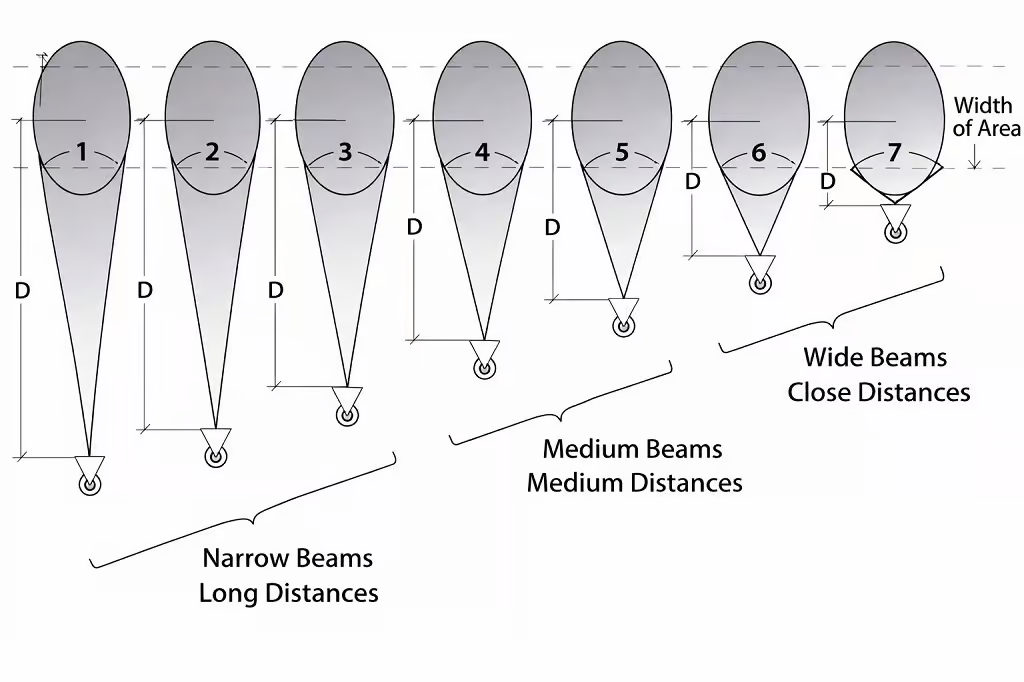
This is a matter of both the light you select as well as its distance from stage. If you need a certain amount of stage covered by a single light, you’ll need to calculate a balance of beam size and distance from the stage.
A narrow beam will allow you to place your light further away from the area of focus. A wider beam can be placed closer to your area of focus.
A smaller area of focus will result in brighter illumination. A larger area of focus will result in a dimmer illumination. (Why’s that? Well, I’m just going to declare “Science” in this course, but if you ever want to sit down and chat about the inverse square law and my butter gun analogy, I would be giddy).
Not every system needs the same amount of granularity. If a system is intended for painting a base layer of rich color or interesting texture, it can be a large wash, similar to using a large paint brush. If a system is intended for pulling small moments from the larger stage using brighter light and lighter colors, it might want to have many smaller areas of focus, similar to using a fine tuned paint brush.
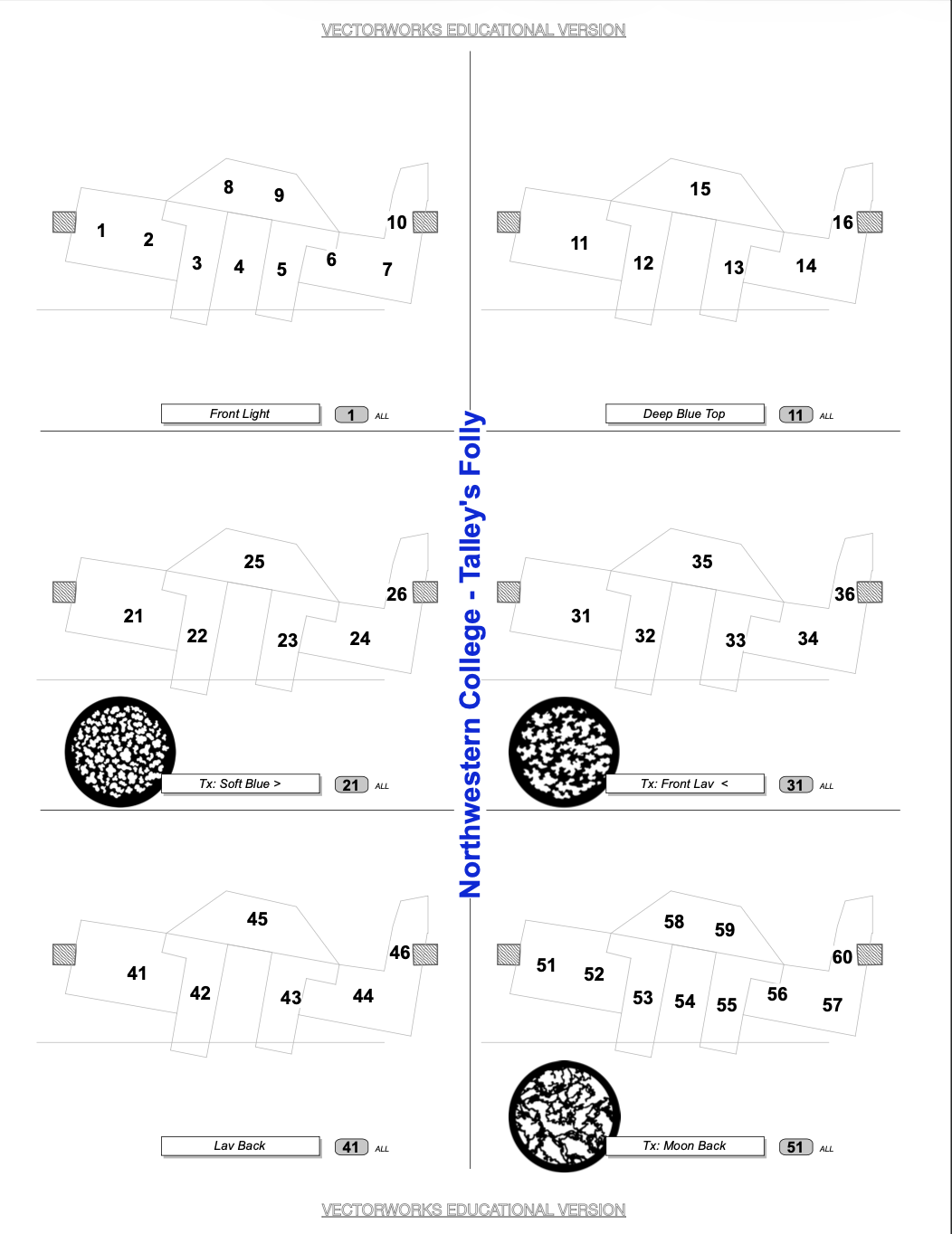
These stylistic choices can be placed in tandem with the scenic design to decide which areas of stage want to be split apart with light. Each area that needs a separate light is referred to as a Focus Area. Combine all of the needs of all of our systems with our focus areas and we can create a Magic Sheet – which is simply a cheat sheet of which channels of light will be focused to which area of the stage. Below, a continuation of our color key from a previous lesson, we can see that we wanted smaller focus areas for our front light and our back moon light. This will allow us to carve out the actors from the richer colors that wash the stage in broad strokes.
Fixture Count
This might be obvious, but it seems to always catch us a little too late. You can have all the best ideas and the most grandiose vision for your design – but if you don’t have the lighting fixtures to execute your vision, then you’re going to have to make some adjustments and concessions. If you don’t have the inventory, you can’t hang the plot. This is one of the reasons LED lights and Moving Lights are so advantageous; they can serve multiple purposes with one light … but of course they’re much more expensive.